


HealthTech QA Services
ByPratik Patel
Mar 31, 2026
HealthTech QA Services ensure healthcare software is safe, compliant, and accurate. Explore AI testing, LLM evaluation, security, and compliance testing strategies for healthcare applications.

Imagine confidently launching your software, knowing that every button click, data transfer, and user interaction works perfectly—no surprises, no last-minute bugs. This level of assurance doesn’t happen by chance; it’s the result of accurate End-to-End (E2E) Testing.
But what exactly does end-to-end testing mean? How does it ensure that your application not only works but grows under real-world conditions? And most importantly, what are the steps and tools that make this testing approach crucial?
In this blog, we are diving deep into the concept of end-to-end testing and also know about its best practices and why it’s the ultimate safeguard for your software’s success.
The Testing Pyramid builds quality from the ground up — Unit to E2E tests, with manual tests at the peak.
More base = fewer bugs, faster releases.
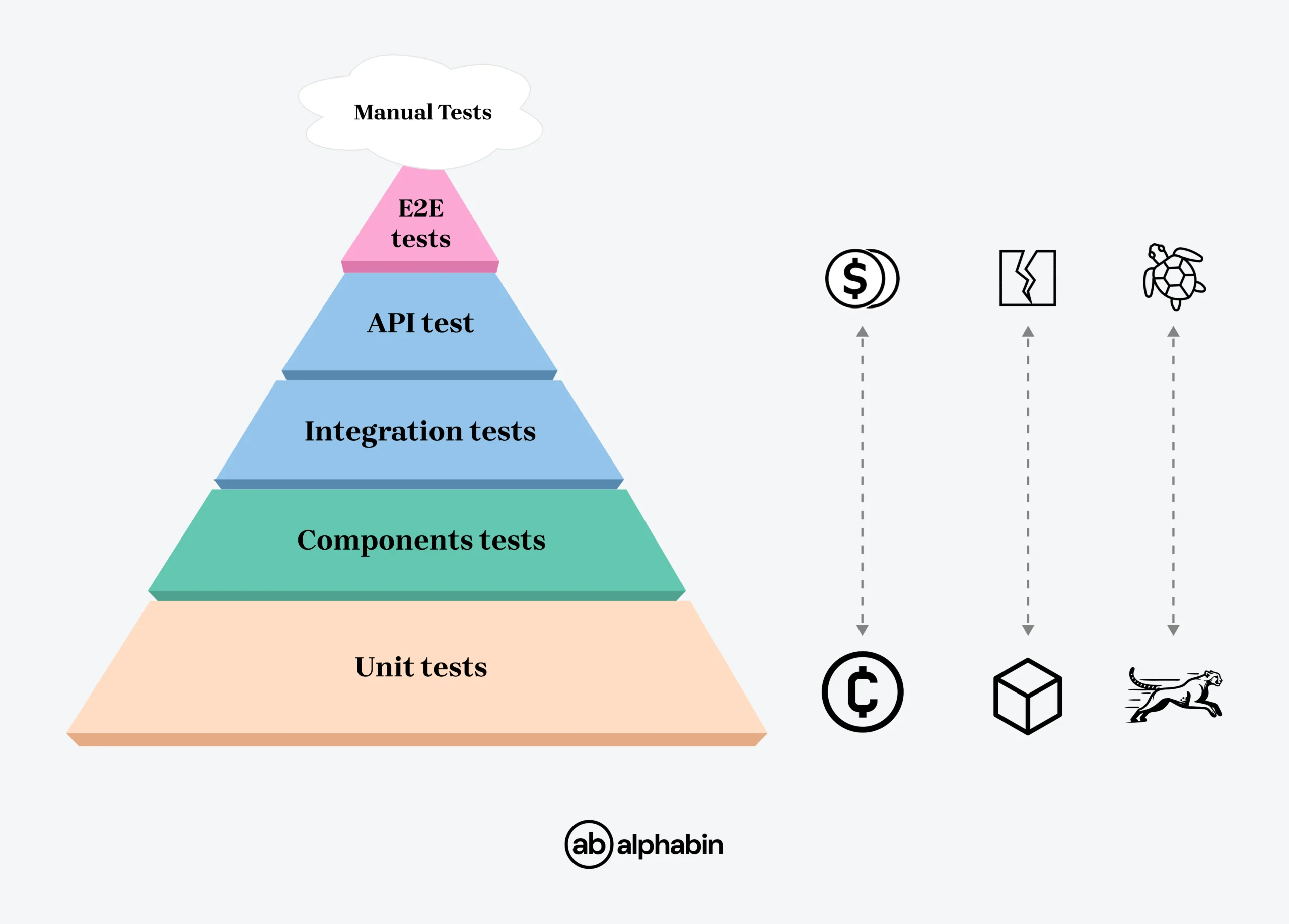
While the Testing Pyramid shows the structure, it’s equally important to understand how much, how fast, and who owns each layer of testing.
Here’s a detailed breakdown:
| Type | No. of Test | Execution Speed | Stability | Written by |
| Unit | 70% | Fast | Solid | Developers |
| Integration | 20% | Medium | Good | QA/Developers |
| UI (E2E) | 10% | Slow | Fragile | QA |
1. Unit Tests
2. Integration Tests
3. UI (E2E) Tests
End-to-end (E2E) testing represents a software testing strategy that evaluates entire application workflows from beginning to end. E2E testing helps components communicate properly in their system framework to deliver true user perspectives about software delivery.
E2E testing is conducted after integration testing and before user acceptance testing (UAT) to identify system-wide issues early. Simulating real user scenarios verifies that the application functions as expected across different modules, databases, and third-party integrations.
For example, a user logs into the OTT app to watch a movie, verifying successful login functionality. They browse the library, ensuring smooth navigation and search capabilities.
After selecting a movie, they test video playback, checking for seamless streaming and adjustable settings. The user pauses and exits, confirming that their progress is saved in the “Continue Watching” section.
End-to-end (E2E) testing should be adopted to ensure your application is confident in performing in a real-world environment. Here’s why you should make it a priority:
End-to-end (E2E) testing involves several key components that work together to ensure the entire application functions seamlessly. Here are the main components:
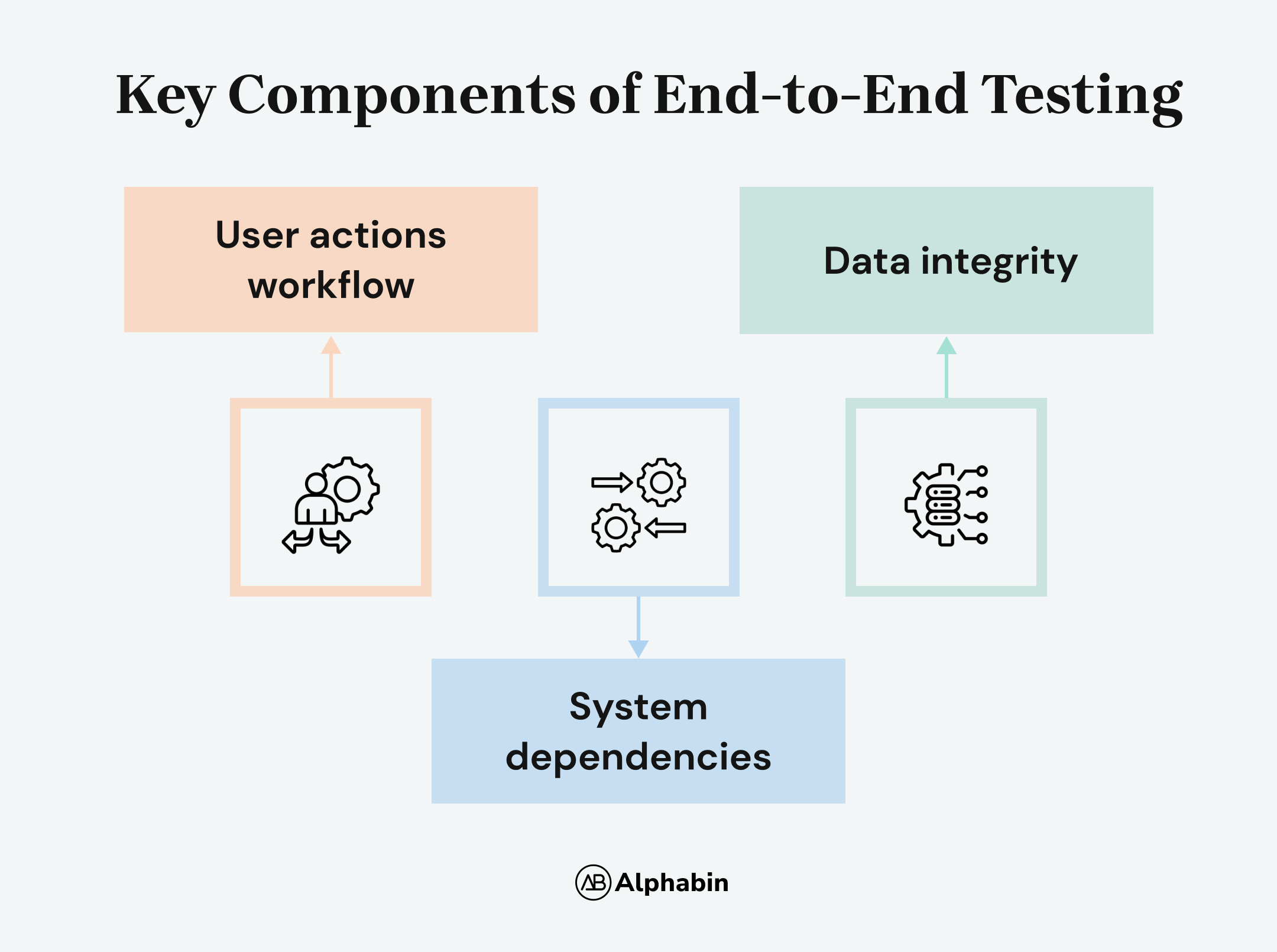
E2E testing closely mimics real users’ activities and scenarios.
E2E testing verifies the communication of various segments of the application.
Maintaining data integrity is vital in E2E testing.
End-to-end testing ensures that your software works as expected across every component, interface, and user interaction. Here are the key types of E2E testing, each designed to validate a specific part of the system’s reliability, performance, or compliance.
1. Functional Testing
Functional testing verifies that each feature works according to the specified requirements. It checks real-world user flows and ensures that business logic behaves correctly across all modules.
2. Performance Testing
This type assesses your application’s responsiveness, stability, and scalability under load. It helps identify performance bottlenecks and ensures the app can handle high traffic smoothly.
3. Usability Testing
Usability testing focuses on the user experience. This ensures that the application is intuitive, accessible, and easy to navigate. This is essential for maximizing user satisfaction and adoption.
4. Security Testing
Security testing evaluates how well the application protects data and resists malicious attacks. It checks for vulnerabilities, misconfigurations, and ensures compliance with security best practices.
5. Compatibility Testing
This ensures the app works consistently across different devices, browsers, operating systems, and network conditions. This is crucial for delivering a seamless experience to all users.
6. Compliance Testing
Compliance testing ensures that the software adheres to legal, regulatory, and organizational standards. This is particularly important in industries like FinTech, healthcare, and SaaS.
As a crucial part of software development, end-to-end testing ensures that the entire application functions as intended from start to finish. Here is a breakdown of the steps involved:
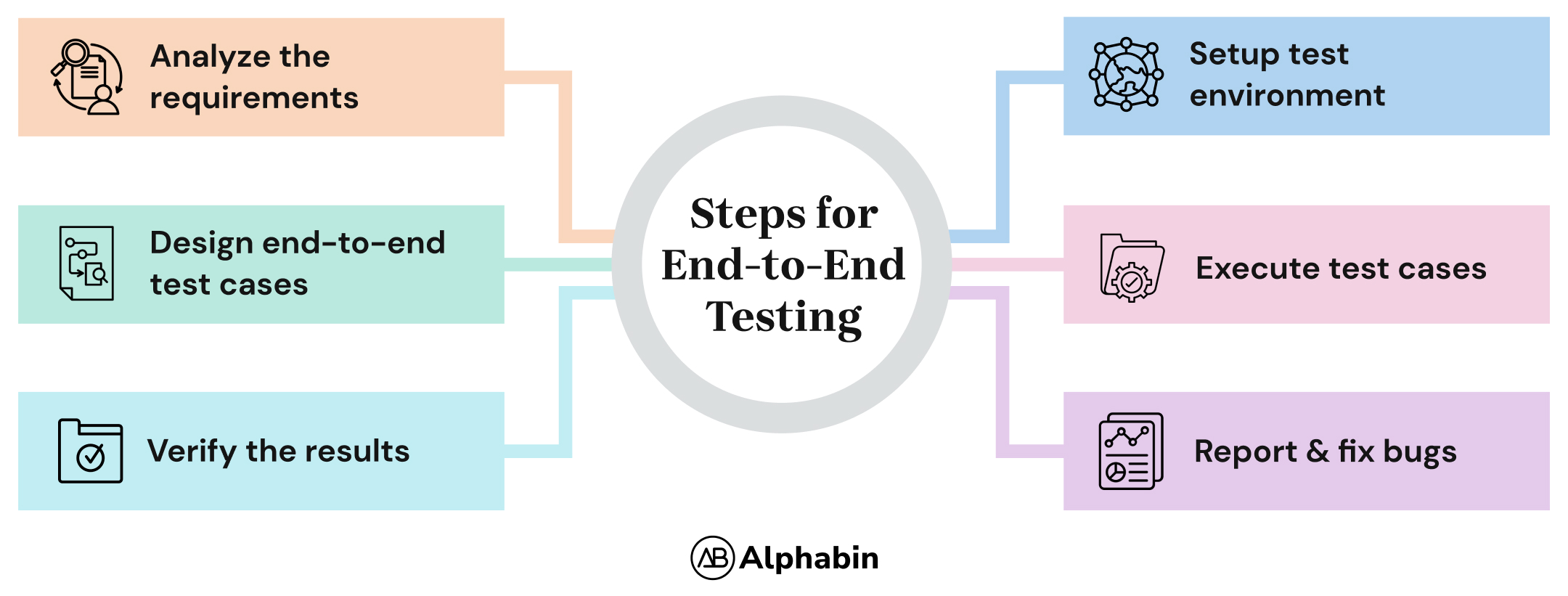
The primary first step is to understand all the application business goals as well as the use cases and workflow processes. This initial step’s goal is to identify which items should be tested and which ones should not be missed.
The second step: establish a testing environment close to the actual environment. To this end, one has to establish the hardware, software, network, and data that will give the best result possible for the test conditions.
The third task, which is the secondary target of the second task, is to create fine-grained test cases that mimic end-to-end user journeys. Test the software for all potential edge cases along with essential features and different scenarios.
As for the fourth step, identify test case execution in your test environment using test automation tools like Selenium, Cypress, Playwright, or Appium. This will allow one to track the process and keep an eye out for any anomalies.
The fifth step is to compare the predicted test results with the actual ones to see how the application carries out the intended operations. This should always be done to record any failures or discrepancies for future reference.
The final step is to note the found defects, assign them based on severity, and with your development team, resolve them. Test the application once again to verify that the implemented repairs have solved the issues without causing new problems.
For performing E2E testing, these tools offer robust solutions for E2E testing, each with unique strengths suited to different testing needs and environments. We mention the top 5 best end-to-end testing tools:
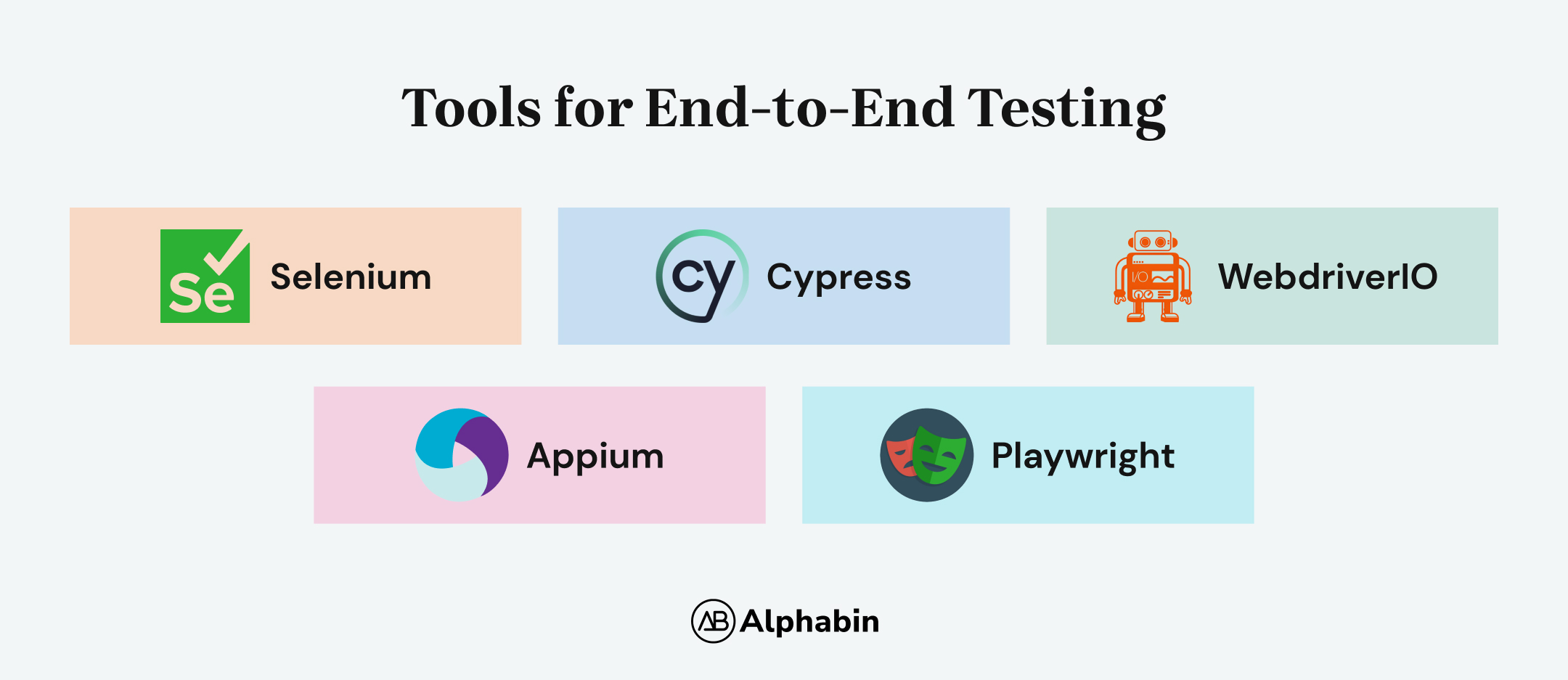
Selenium is an open-source tool implemented for browser automation testing, and it is among the most used tools. Known for its flexibility, Selenium 4 features advanced functionalities that enhance browser automation capabilities. It supports more than one programming language, like Java, Ruby, C#, or Python, and can be implemented on different browsers and operating systems. Selenium is rather flexible, and it is fairly often utilized for web app testing.
Cypress is a fast-moving tool for carrying out end-to-end testing of web applications. It is designed for the new JavaScript framework and has a rich set of built-in tools to write and run tests. Cypress provides the capabilities of real-time reload, automatic waiting, and it has a built-in test result panel.
WebDriverIO is one of the most popular open source testing tools designed for the testing of graphical user interface web applications. It employs the WebDriver protocol for controlling the web browsers for end-to-end testing. It supports several browsers like Google Chrome, Mozilla Firefox, Apple Safari, and Microsoft Edge, among others.
Appium is an open-source tool that allows mobile app testing for native, hybrid and web applications. It is compatible with both iOS and Android and enables the tester to write their tests in popular languages. Using Appium, it is possible to provide a cross-platform and powerful solution for mobile app end-to-end testing.
Playwright is a testing tool that lets you execute test automation on any device and browser located in the cloud. It includes most of the modern web frameworks and provides numerous opportunities for debugging and monitoring the test results and reporting the outcomes of tests.
For a deeper comparison between two of the top end-to-end testing tools, Playwright and Cypress, check out our blog. It provides insights on their strengths, differences, and how to choose the right tool for your project needs.
End-to-end (E2E) testing is one of the most important tests that is aimed at the proper work of the application from the beginning to the end. To maximize its effectiveness, here are some best practices you should follow:
Prioritize Key User Flows
Avoid Unnecessary Exception Testing
Reduce UI Test Flakiness
Run Tests in Parallel
End-to-end testing is essential for ensuring that your application functions seamlessly from start to finish. By simulating real-world user interactions and verifying the entire workflow, E2E testing helps identify and resolve issues that could impact the user experience. It validates that all components, including those verified during unit testing, work together as expected, ensuring a smooth and reliable application.
By working together with the Alphabin team, one can guarantee that the software is efficient, safe, and functional on every operating system. Allow Alphabin to assist you in providing software quality via end-to-end testing and various software testing services.
Pratik Patel is the founder and CEO of Alphabin, an AI-powered Software Testing company. He has over 10 years of experience in building automation testing teams and leading complex projects, and has worked with startups and Fortune 500 companies to improve QA processes. At Alphabin, Pratik leads a team that uses AI to revolutionize testing in various industries, including Healthcare, PropTech, E-commerce, Fintech, and Blockchain.
ByPratik Patel
Mar 31, 2026
HealthTech QA Services ensure healthcare software is safe, compliant, and accurate. Explore AI testing, LLM evaluation, security, and compliance testing strategies for healthcare applications.

ByPratik Patel
Mar 10, 2026
Discover how AI test automation and manual testing work together to enhance quality assurance. Learn strategies, tools, and best practices for modern software testing

ByPratik Patel
Mar 5, 2026
Automation testing and AI engineering roadmap for QA professionals. Learn Playwright, Selenium, CI/CD, and AI skills to grow your tech career.