

A clinical decision support tool suggests the wrong medication dose. A telehealth platform exposes 50,000 patient records. An AI diagnostics chatbot confidently gives incorrect test results.
These are not just rare cases; they are real risks when healthcare software is released without proper HealthTech QA Services and healthcare software testing.
Healthcare software cannot afford mistakes. In other industries, bugs can cause financial loss or inconvenience. But in healthcare, even a small error can affect patient safety and trust.
That is why QA services for healthcare applications are very different from regular software testing.
This is where HealthTech QA Services play a critical role. They ensure that healthcare systems are accurate, secure, compliant, and reliable. With the rise of AI, AI testing in healthcare and LLM testing in healthcare have become essential to prevent issues like incorrect outputs, bias, or unsafe recommendations.
In this guide, we will explain what HealthTech QA Services include, why testing AI applications in healthcare needs a different approach, and how to build a strong QA strategy.
What Are HealthTech QA Services?
Healthcare QA has existed for years through manual testing, compliance checks, and regulated validation to ensure software meets requirements. Today, HealthTech QA Services go beyond this by supporting complex systems and advanced healthcare software testing needs.
Modern healthcare platforms use AI, real-time data, and digital tools, making QA services for healthcare applications, including AI testing and LLM testing, essential. These services ensure accuracy, compliance, and safety through proper testing of AI applications in healthcare and LLM evaluation for healthcare enterprises.
{{cta-image}}
Why QA Is Critical in Healthcare
Let’s be direct about what is actually at stake.
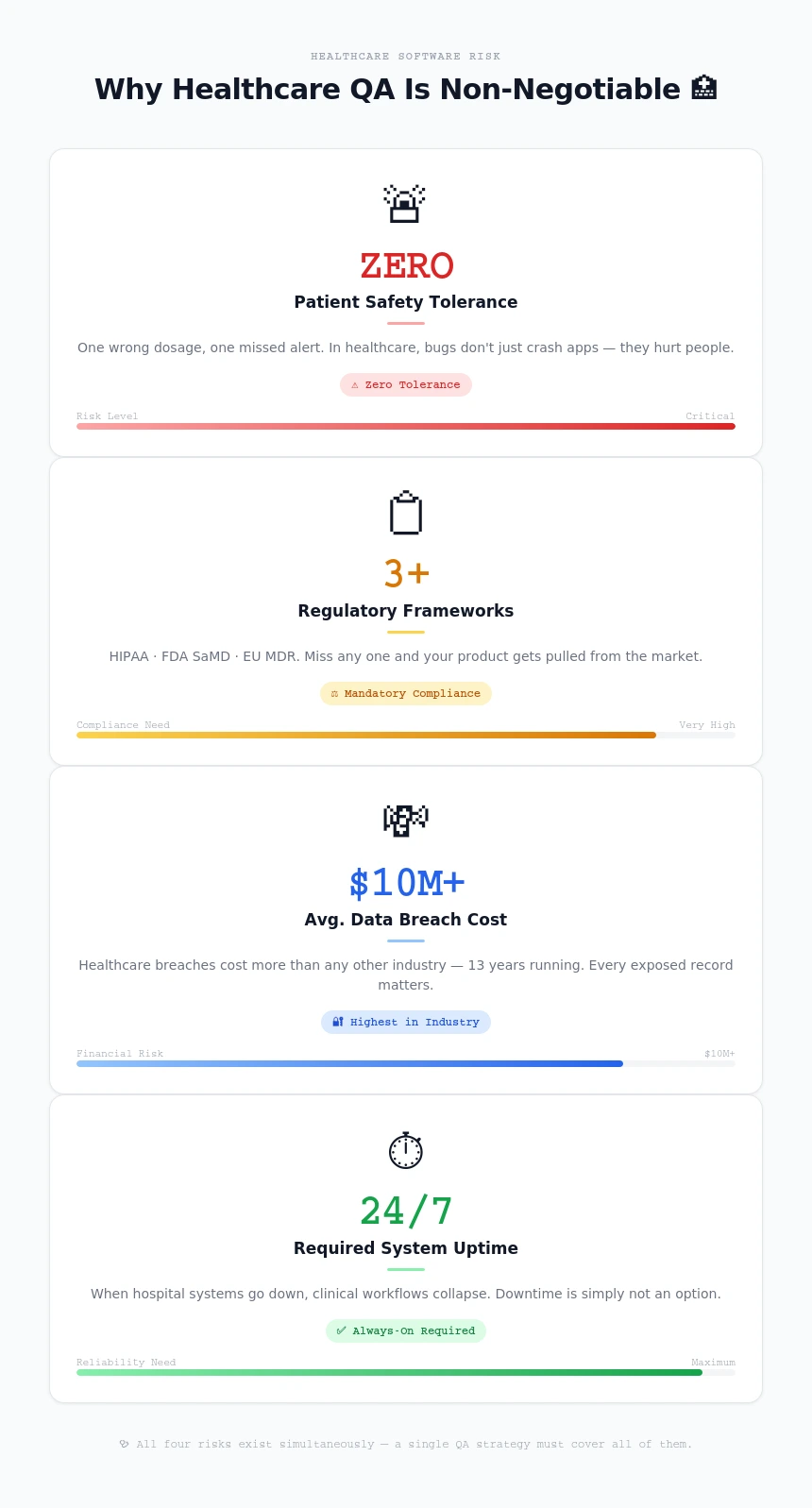
1. Patient safety comes first
- A bug in a medication dosing calculator, a failure in a critical alert system, or a wrong output from an AI tool can directly harm patients.
- That is why HealthTech QA Services, along with proper healthcare software testing, AI testing in healthcare, and LLM testing in healthcare, are essential because healthcare has zero tolerance for critical failures.
2. Regulatory requirements are non-negotiable
- HIPAA defines how patient data should be stored and accessed, while FDA SaMD and EU MDR require strict validation.
- Strong QA services for healthcare applications and compliance testing healthcare software help meet these rules, because failure can lead to fines or even removal from the market.
3. Data privacy risks are severe
- Healthcare data includes sensitive details like diagnoses, medications, and mental health records.
- Reliable healthcare QA solutions and proper testing of AI applications in healthcare help prevent costly breaches, while LLM evaluation for healthcare enterprises ensures secure handling of data.
4. System reliability cannot be optional
- When healthcare systems fail, it can stop critical operations in hospitals.
- This is why HealthTech QA Services ensure systems work smoothly under heavy load and deliver consistent performance every time.
Why Testing AI in Healthcare Is Different
Standard QA assumes software behaves in a fixed way. You give input A and expect output B, and if it does not match, it is treated as a bug.
This approach works for traditional systems but not for AI testing in healthcare, where HealthTech QA Services and advanced healthcare software testing are required.
- AI systems do not behave in a fixed way
- Large language models and machine learning systems can give different outputs for the same input.
- This is why LLM testing in healthcare and proper testing of AI applications in healthcare focus on evaluation methods instead of exact output matching.
- Hallucinations can be dangerous in healthcare
- If an AI system gives incorrect or made-up medical information, it can lead to serious risks.
- Strong healthcare QA solutions and LLM evaluation for healthcare enterprises are needed to detect and prevent such issues.
- Bias in medical AI has a real impact
- AI models trained on past healthcare data may not perform equally for all groups.
- This makes QA services for healthcare applications and bias testing an important part of HealthTech QA Services.
- Ethical risks are real and regulated
- Regulations like FDA guidelines and EU AI rules require AI systems to be accurate, fair, and explainable.
- This makes compliance testing healthcare software and proper validation essential in modern healthcare QA.
Core Pillars of HealthTech QA Services
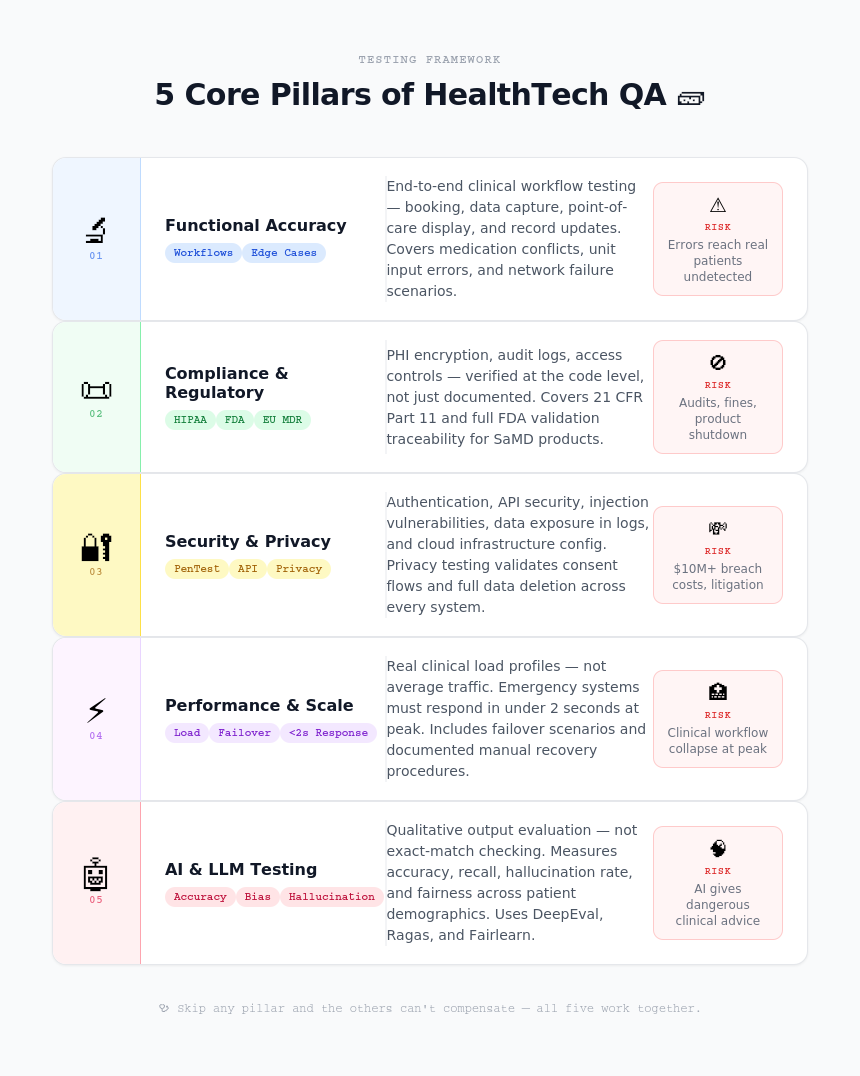
1. Functional Accuracy Testing
This is the foundation of HealthTech QA Services. The software must do exactly what it is supposed to do.
- For healthcare software testing, this means checking full clinical workflows from start to end.
- A patient books an appointment, the system stores correct data, the doctor sees accurate information, and the records update properly.
- Any break in this process can impact patient safety.
Functional testing also includes edge cases that other industries may ignore.
For example, handling multiple medications, incorrect unit inputs, or system errors during network issues. Strong QA services for healthcare applications ensure these cases are tested properly.
Without proper functional testing, errors can reach real patients. This is why HealthTech QA Services are critical.
2. Compliance and Regulatory Testing
Healthcare systems must follow strict regulations. HealthTech QA Services ensure that software meets these requirements through detailed compliance testing of healthcare software.
- This includes testing HIPAA rules such as data encryption, audit logs, and access control.
- It also involves FDA requirements like 21 CFR Part 11 and validation based on intended use.
If compliance is not tested properly, companies may face audits, penalties, or product shutdown. This makes healthcare QA solutions essential for safe and legal operations.
3. Security and Data Privacy Testing
Healthcare data is highly sensitive and a common target for cyberattacks. HealthTech QA Services include strong security testing as part of healthcare software testing.
- This involves testing authentication, API security, vulnerabilities, and data exposure risks.
- It also checks cloud infrastructure security for modern applications.
Privacy testing ensures correct data usage. It verifies data collection limits, consent handling, and proper data deletion. These are key parts of QA services for healthcare applications.
4. Performance and Scalability Testing
Healthcare systems must perform well under pressure. HealthTech QA Services ensure systems handle real-world usage without failure.
- For example, emergency systems must respond quickly, telehealth platforms must support many users, and monitoring systems must process continuous data.
Performance testing includes real usage scenarios, load handling, and system recovery checks. This ensures reliable healthcare QA solutions for critical environments.
5. AI and LLM Testing in Healthcare
This is one of the most important areas today. AI testing in healthcare and LLM testing in healthcare require a different approach than traditional testing.
- Instead of checking exact outputs, testing focuses on evaluating accuracy, safety, and relevance.
- Testing AI applications in healthcare includes checking for hallucinations, bias, and incorrect results.
With proper LLM evaluation for healthcare enterprises, teams can measure accuracy, recall, precision, and factual correctness at scale. This makes AI systems safer and more reliable in healthcare.
{{cta-image-second}}
AI and LLM Testing in HealthTech: A Closer Look
The use of AI in healthcare is growing rapidly. Many systems, like clinical assistants, patient chatbots, discharge summary tools, and diagnosis support tools, are already in use or being developed.
All of these require strong HealthTech QA Services, especially AI testing in healthcare and LLM testing in healthcare.
Every one of these systems needs proper validation through testing AI applications in healthcare. Without this, errors can affect patient safety and system reliability.
Use cases that need careful validation:
Healthcare chatbots used for symptom checking or triage must avoid giving direct diagnoses while still being helpful. This is where LLM testing in healthcare and healthcare QA solutions are important, because the system must stay within safe boundaries.
AI-generated clinical notes and summaries can save time but may include errors or miss critical details. Proper healthcare software testing and LLM evaluation are needed for healthcare enterprises to ensure accuracy at scale.
Diagnostic support tools that suggest possible conditions must be tested carefully. They require strong QA services for healthcare applications to ensure accuracy across different patient groups and to detect cases where the AI is confidently wrong.
Three evaluation frameworks are important for LLM evaluation in healthcare enterprises:
DeepEval helps measure output quality based on accuracy, relevance, and hallucination rate. It supports continuous testing, which is useful in AI testing in healthcare workflows.
Ragas is designed for systems that use external data sources before generating answers. It evaluates answer quality, context accuracy, and relevance, making it useful for testing AI applications in healthcare.
Fairlearn focuses on detecting bias in AI systems. In healthcare, it helps ensure that models perform fairly across different patient groups, which is a key part of HealthTech QA Services.
Building a Solid HealthTech QA Strategy
Good HealthTech QA Services do not happen by accident. It requires proper planning before development begins in healthcare software testing.
- Test case design for healthcare needs to focus on clinical risk. Not all failures are equal, and QA services for healthcare applications must prioritize high-risk areas like medication calculations over minor UI issues.
- Synthetic data vs real healthcare data is an important decision. Real patient data is accurate but creates privacy risks, while synthetic data helps in safe compliance testing of healthcare software, but it must still cover important edge cases.
- Evaluation metrics for AI systems should include accuracy, recall, precision, and F1 score. In AI testing in healthcare and LLM testing in healthcare, additional metrics like faithfulness, hallucination rate, and clinical relevance are also important for LLM evaluation for healthcare enterprises.
- Continuous validation is critical because AI systems change over time. This is why HealthTech QA Services must include ongoing testing to ensure reliable healthcare QA solutions.
Risks of Poor QA in Healthcare
Here is what actually happens when HealthTech QA Services and proper healthcare software testing are not taken seriously.
- A large health system launches an AI triage chatbot without proper AI testing in healthcare and LLM testing in healthcare. The system gives wrong advice in edge cases, such as telling a patient with chest pain that it is likely anxiety, which delays medical care. This shows why testing AI applications in healthcare and LLM evaluation for healthcare enterprises are critical.
- A digital health company releases a patient data system without full security checks. A weak API exposes thousands of patient records, leading to legal issues and loss of trust. This highlights the need for strong QA services for healthcare applications and compliance testing of healthcare software.
- A healthcare company fails to validate its software under the required regulations. When asked for proper documentation, they cannot provide it, and the product is removed from the market. This shows why healthcare QA solutions and regulatory testing are essential.
These situations are not rare. They are common outcomes when HealthTech QA Services are ignored or treated as a low priority in healthcare software development.
{{cta-image-third}}
Conclusion
HealthTech QA Services are essential to ensure healthcare software is safe, accurate, and compliant, especially with the growing complexity of healthcare software testing and AI-driven systems.
At Alphabin, strong QA services for healthcare applications combined with AI testing in healthcare and LLM testing in healthcare help reduce risks, improve system reliability, and protect patient safety.
In the end, investing in HealthTech QA Services and continuous healthcare QA solutions ensures your systems are ready for real-world clinical use without compromising trust or compliance.
FAQs
1. What are HealthTech QA Services?
HealthTech QA Services are specialized healthcare software testing processes that ensure healthcare applications are safe, compliant, and reliable. They include functional testing, security testing, and AI testing in healthcare.
2. Why is QA important in healthcare applications?
QA is important because even small errors can impact patient safety and data privacy. Proper QA services for healthcare applications help prevent risks and ensure compliance with regulations.
3. What is AI testing in healthcare?
AI testing in healthcare involves validating AI systems to ensure they provide accurate and safe outputs. It includes checking for errors, bias, and reliability in real-world scenarios.
4. What is LLM testing in healthcare?
LLM testing in healthcare focuses on evaluating large language models used in clinical tools and chatbots. It ensures outputs are accurate, safe, and free from hallucinations through proper LLM evaluation for healthcare enterprises.
5. How do HealthTech QA Services help with compliance?
They ensure systems follow regulations like HIPAA and FDA guidelines through proper compliance testing of healthcare software. This helps avoid legal risks and protects patient data.


.svg)


.svg)

.png)
.png)
.png)



.svg)