


HealthTech QA Services
ByPratik Patel
Mar 31, 2026
HealthTech QA Services ensure healthcare software is safe, compliant, and accurate. Explore AI testing, LLM evaluation, security, and compliance testing strategies for healthcare applications.

Fintech apps have become an undeniable force in our daily lives. From mobile banking and investment platforms to peer-to-peer payments and digital wallets, fintech solutions offer smooth management of our finances.
But that convenience also brings with it the bottle: the critical responsibility to verify and secure the transaction. The financial loss, regulatory penalties, and customer distrust result from minor errors in the transaction flows, such as failed payments, incorrect fund transfers, or some security breaches. This could be late or inaccurate payment, debit or credit error, or even fraud.
🚨 Research shows that credit card fraud damages alone are going to reach over $35 billion globally by 2025. 🚨
This is where transaction flow testing ensures that each transaction process in a Fintech app is verified, resulting in a smooth and secure user experience. It involves testing every step, from user input and validation to data processing, system interaction, and final transaction completion.
Transaction flow testing is a form of software testing wherein you test the sequence of steps to run a financial transaction from inception to conclusion. This helps ensure that transactions are executed correctly and with security and to the best of business rules and regulatory standards.
When it comes to Fintech, banking, or e-commerce applications, it is of utmost importance to keep a transaction process seamless, secure, and error-free. The purpose of TFT is to verify the generic functionality of a single transaction that begins from the sake of initiation to that of completion without financial errors, security failures, or system crashes.
Satisfying these objectives in transaction flow testing, whether manual or automation testing, ensures that the software system will provide a process for reliable and effective transaction processing, contributing to overall system stability and user satisfaction.
Financial transactions in fintech apps are complex and critical and thus creating the transaction flow testing in software testing is a challenge. Security risk, regulatory compliance requirements, integration challenges, and scalability concerns are parts of challenges that can cause bad customer satisfaction if they’re not dealt with appropriately.
| Challenges | Detail | Example |
|---|---|---|
| Dynamic data and Testing scenarios | Financial transactions usually include fluctuating information such as monetary values and dates. To achieve comprehensive testing, an application must be evaluated for correct functionality across different operational conditions and situations. | The testing of bill payment functionality needs to include testing scenarios for recurring payments as well as partial and oversized payments and future-scheduled date payments. |
| Striking a balance in test coverage | Successful navigation of comprehensive test coverage against efficient testing execution presents a substantial and complex task to testers. To achieve adequate test coverage testers must successfully handle many scenarios effectively. | The process of creating separate test cases for all potential amount-frequency-recipient type pairs proves both difficult to handle and time-intensive. Testers should focus on essential scenarios and employ methods that may extend past their present capabilities. |
| The complexity of the system | The complexities of current fintech applications result in challenging functionalities that combine with various external APIs and internal systems. The intricate system of transactions proves challenging for complete testing of all potential scenarios. | Testing how an investment application deals with stock splits, which distribute existing shares into different units. Testers must evaluate the impact of splitting shares on user shares alongside account balances and order processing among different linked systems. |
| Security concerns beyond functionality | Security vulnerabilities exist in transaction flows due to exploitable weaknesses. Testing mobile platforms requires security checks beyond functional testing because they need to detect and eliminate potential security threats. | Mobile banking app a seemingly simple money transfer function could be vulnerable to man-in-the-middle attacks if not properly secured, giving clear access to unauthorized access and fraudulent transactions. |
Software testing through transaction flow methods creates a systematic system to find and resolve problems within the transaction processes of applications. Testers can trace every step in a transaction to make this process smooth so that users can enjoy seamless security.
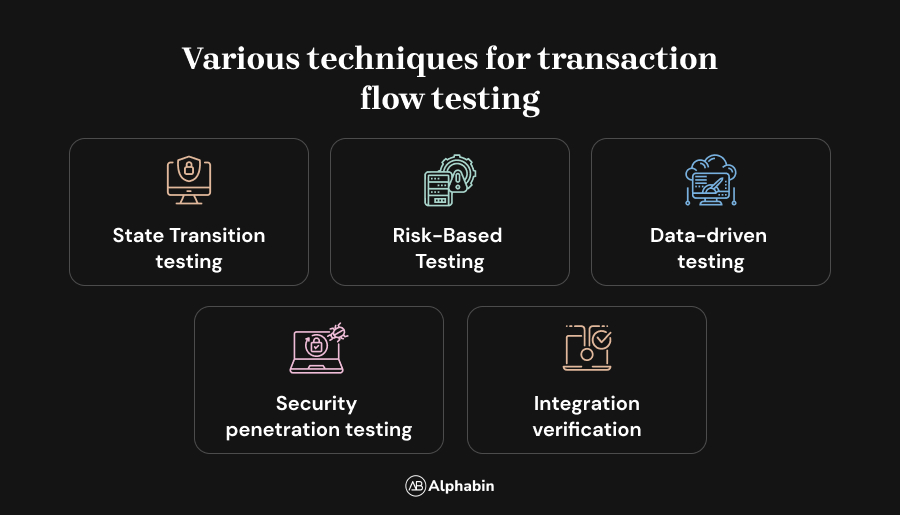
This technique verifies that the app behaves correctly during the transition of states (e.g. pending, completed, failed) during transactions. It makes sure everything has a smooth passage and matches well with various transaction statuses.
Implementation guide:
Pros:
Cons:
To balance out the challenge of testing coverage, risk-based testing helps us focus on priorities that have a critical impact and high probability of occurrence. Otherwise, there is no need to spend testing resources on non-relevant scenarios.
Implementation guide:
Pros:
Cons:
To address the challenge of dynamic data and testing scenarios, we incorporate data-driven testing. Which leverages external data sources to create a wider range of test scenarios, ensuring the app functions correctly under diverse conditions.
Implementation guide:
Pros:
Cons:
Financial transactions present a primary goal for those who conduct attacks. The process of penetration testing extends past functional testing to find vulnerabilities that can be exploited in transaction flow testing. Through simulated attacks, organizations locate security vulnerabilities that malicious actors could use before they become functional threats.
To learn in-depth about penetration testing, check out our penetration testing service page.
Implementation guide:
Pros:
Cons:
Such modern fintech apps inherently integrate with many external APIs for paying, getting stock quotes, credit checks, etc. Testing these integrations is a critical part of proving the flow of transactions because of the fintech systems’ complexity.
Implementation guide:
Pros:
Cons:
Finally, we urge fintech testers to conduct extensive transaction testing to prevent their risks and gain users’ trust. As Fintech systems are complex, achieving such a balance between complete test coverage and customer security concerns beyond its functionality, we strike to provide a secure and reliable user journey.
Testing for FinTech is still evolving, and so are the products of FinTech, so we share that the final thing a FinTech tester should continue to do is to validate the transaction flow and ensure the highest accuracy and security. Keep updating the transaction flow strategies in software testing according to new threats and regulatory changes, and work closely with security teams and the development process to counter the vulnerabilities found.
By prioritizing transaction flow testing in software testing and embracing best practices, fintech testers can contribute to the success and longevity of their applications in an ever-changing landscape. For any inquiries regarding fintech testing or QA services in general, reach out to us.

Founder and CEO
Pratik Patel is the founder and CEO of Alphabin, an AI-powered Software Testing company. He has over 10 years of experience in building automation testing teams and leading complex projects, and has worked with startups and Fortune 500 companies to improve QA processes. At Alphabin, Pratik leads a team that uses AI to revolutionize testing in various industries, including Healthcare, PropTech, E-commerce, Fintech, and Blockchain.
ByPratik Patel
Mar 31, 2026
HealthTech QA Services ensure healthcare software is safe, compliant, and accurate. Explore AI testing, LLM evaluation, security, and compliance testing strategies for healthcare applications.

ByPratik Patel
Mar 10, 2026
Discover how AI test automation and manual testing work together to enhance quality assurance. Learn strategies, tools, and best practices for modern software testing

ByPratik Patel
Mar 5, 2026
Automation testing and AI engineering roadmap for QA professionals. Learn Playwright, Selenium, CI/CD, and AI skills to grow your tech career.