

In 2012, Knight Capital Group lost $440 million in just 45 minutes. The cause? A software deployment error that no one caught during testing. There was no rollback plan. By the time engineers found the issue, thousands of wrong trades had already been executed.
This is not a small startup mistake. This happened to a billion-dollar company with a full engineering and QA team.
This is exactly why FinTech QA Services are so important.
In normal software, a bug might only affect user experience. But in fintech applications, even a small bug can lead to:
- Loss of money
- Legal and compliance issues
- Loss of customer trust
That’s why fintech testing and financial software testing need a much higher level of accuracy, security, and reliability compared to regular QA.
In this article, we will explain:
- What FinTech QA Services include
- Why QA for fintech applications is different from traditional testing
- How to build a strong banking software testing strategy
- And how proper payment system testing helps keep your platform secure and compliant
What Are FinTech QA Services?
FinTech QA Services are specialized testing and quality assurance processes created specifically for financial technology applications. These include mobile banking apps, payment gateways, lending platforms, trading systems, insurance software, and any other system that handles money or financial data.
The scope of fintech testing is much wider than regular testing. It is not just about checking if a button works or if a form submits correctly. In financial software testing, the focus is on accuracy, security, and compliance.
With proper QA for fintech applications, you need to make sure that:
- Transactions are executed correctly in every possible situation
- Sensitive financial data is protected at every level
- The system follows standards like PCI DSS, GDPR, and SOC 2 (important for compliance testing in fintech)
- Performance remains stable even when transaction volumes increase suddenly
- Third-party integrations do not create risks or failures (important in payment system testing)
In simple terms:
- Standard QA asks: “Does the software work?”
- FinTech QA Services ask: “Does the software work correctly, securely, and legally every single time?”
{{cta-image}}
Why FinTech QA Is Different from Traditional Software Testing
Most software teams treat QA as just a final check before release. In fintech, this approach can create serious risks. FinTech QA Services require a much deeper and more continuous testing strategy.

Here is what makes financial software testing different from traditional QA.
1. The Cost of Failure Is Not Comparable
In regular software, a bug might only cause a poor user experience.
For example, an issue on an e-commerce site may lead to a few abandoned carts.
But in fintech, failures are much more serious. A broken payment system can lead to:
- Unauthorized transactions
- Regulatory investigations
- Customer complaints and lawsuits
This is why fintech testing and payment system testing must focus on accuracy and reliability. The impact is not small. It grows quickly and can damage both finances and brand reputation.
2. Regulatory Requirements Are Non-Negotiable
Fintech platforms must follow strict rules and standards. These include:
- PCI DSS for handling card data
- GDPR for protecting user data
- Local banking regulations
In compliance testing for fintech, meeting these standards is critical. Not following them is not just a legal issue. It can shut down your business.
That is why QA for fintech applications must treat compliance as a core part of testing, not something added later.
3. Real-Time Transactions Leave No Room for Latency
In fintech systems, speed is very important. Even a small delay can cause major problems, such as:
- Failed transactions
- Duplicate charges
- Settlement errors
- Broken audit records
In banking software testing, performance is not just about speed. It is about making sure transactions are completed correctly under real-world conditions.
4. Security Is a Core Requirement, Not Optional
Financial systems are a major target for cyber attacks. Hackers look for:
- Injection vulnerabilities
- Weak authentication
- Unsafe APIs
- Poor encryption
Because of this, financial software testing must always include strong security checks.
Security testing is not a one-time activity. In FinTech QA Services, it is part of every development cycle to ensure continuous protection.
This is why FinTech QA Services are very different from traditional QA. They focus on security, compliance, performance, and accuracy at every stage of development.
{{cta-image-second}}
Key Testing Areas in FinTech QA Services
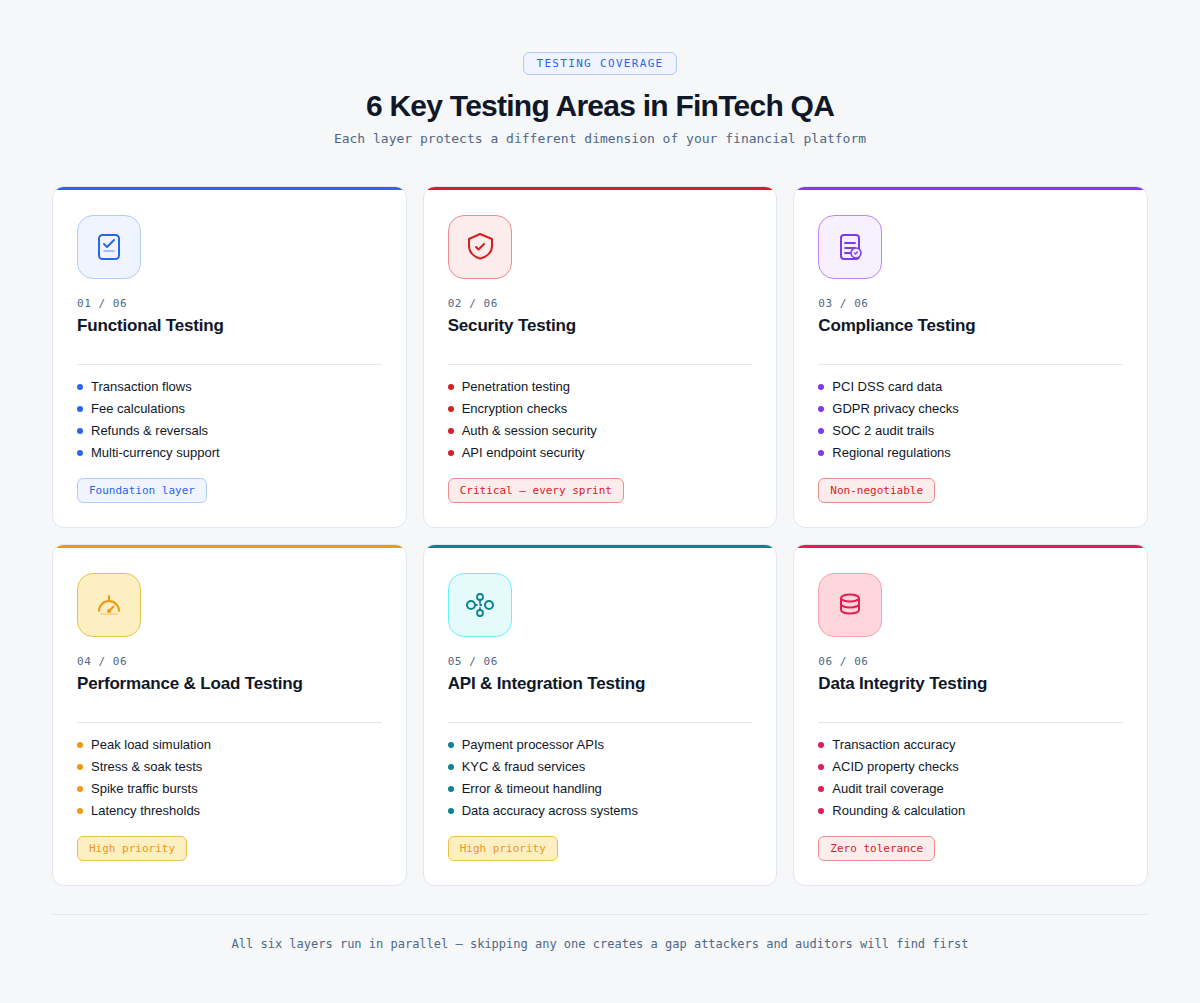
1. Functional Testing
This is the base of FinTech QA Services. Functional testing checks if your application works exactly as expected.
In financial software testing, this means testing complete transaction flows from start to end. For example, when a user makes a payment:
- The correct account should be debited
- The payment should go through the right processor
- The correct receiver should get the money
- All records should be updated properly
Even a small error, like a rounding issue, is considered a defect in fintech testing.
Functional testing in QA for fintech applications usually includes:
- Account creation and management
- Fund transfers, both local and international
- Interest and fee calculations
- Refunds and transaction reversals
- Multi-currency support
- User login and session management
2. Security Testing
Security is one of the most important parts of FinTech QA Services. A security issue is not just a bug. It is a serious risk.
Financial software testing must include strong security checks, such as:
- Penetration testing: Simulates real attacks to find weaknesses before hackers do
- Static and dynamic analysis: Checks code and running applications for security issues
- Encryption verification: Ensures sensitive data like card details and personal information is protected during transfer and storage
- Authentication testing: Confirms login systems, multi-factor authentication, and access controls are secure
- API security testing: Important for payment system testing, since APIs are widely used and can be vulnerable if not secured
3. Compliance Testing
Compliance testing for fintech ensures your platform complies with all applicable regulations.
In FinTech QA Services, this includes:
- PCI DSS for card data protection
- GDPR for user data privacy
- Local banking regulations
For example:
- PCI DSS checks how card data is stored and processed
- GDPR checks user consent, data storage, and deletion processes
This is not just about documentation. QA for fintech applications ensures the software actually follows these rules in real use.
4. Performance and Load Testing
Fintech systems often fail during high traffic, not during normal usage.
In banking software testing, performance testing checks how systems behave under pressure, such as:
- Market opening spikes
- High transaction periods
- Payroll processing times
Fintech testing includes:
- Load testing: Checks performance under expected peak usage
- Stress testing: Finds system limits and breaking points
- Soak testing: Tests system stability over long periods
- Spike testing: Checks how the system handles sudden traffic increases
Key metrics in financial software testing include transaction success rate, response time, and error rate.
5. API and Integration Testing
Modern fintech platforms depend on multiple external systems, such as:
- Payment processors
- Credit bureaus
- Banking networks
- KYC providers
- Fraud detection systems
Each connection is a risk point.
In payment system testing and fintech testing, API testing ensures:
- Data shared between systems is correct
- Authentication between services is secure
- Errors are handled properly when third-party systems fail
- Rate limits and timeouts are managed correctly
6. Data Integrity Testing
In fintech, data accuracy is critical. Even a small mistake can create major issues.
For example:
- Incorrect transaction amounts
- Wrong fees
- Invalid timestamps
These errors can cause reconciliation problems that take a long time to fix.
Data integrity testing in FinTech QA Services ensures:
- Data remains accurate during input, storage, and processing
- Data transformations do not introduce errors
- Systems follow ACID properties, meaning data is atomic, consistent, isolated, and durable
Challenges That Make FinTech Testing Hard
1. Complex System Ecosystems
Modern fintech platforms are highly connected. A single application may depend on many external services.
In FinTech QA Services, this creates complexity because you are not only testing your own system. You also need to test how it behaves when:
- External services are slow
- APIs return errors
- Third-party systems go offline
This makes fintech testing and payment system testing much more challenging than regular software testing.
2. Third-Party Dependencies You Do Not Control
In financial software testing, many systems depend on third-party services such as:
- Payment processors
- Banking networks
- Credit bureaus
The problem is that you cannot always test using real systems. Sandbox environments often do not behave exactly like production systems.
In QA for fintech applications, simulating these systems correctly is very difficult. If not done properly, it can give false confidence and hide real issues.
3. Fraud Scenarios Are Hard to Simulate
Fraud detection is a key part of FinTech QA Services, but it is not easy to test.
Fraud patterns:
- Change frequently
- Are complex and unpredictable
In fintech testing, it is not enough to test known fraud cases. You need to create realistic attack scenarios.
Many teams struggle with this because it requires deep domain knowledge and advanced testing strategies.
4. Regulatory Requirements Vary by Market
Fintech platforms that operate in multiple countries must follow different regulations in each region.
In compliance testing for fintech, passing one region’s requirements does not mean you meet others.
This creates ongoing challenges in:
- Banking software testing
- Maintaining compliance across markets
- Updating systems as regulations change
5. Test Environment Parity
Fintech production environments are complex and hard to replicate.
In FinTech QA Services, a proper test environment should include:
- Realistic data volumes
- Same third-party integrations
- Similar security settings
Creating such an environment for financial software testing is expensive and difficult to maintain. Without it, testing may miss critical issues.
Modern Tools and Frameworks for FinTech Testing
A strong FinTech QA Services strategy depends on using the right tools for each type of testing. In fintech testing and financial software testing, selecting the right stack helps teams maintain accuracy, security, and performance.
Here is a simple overview of commonly used tools:
Why Tool Selection Matters
In FinTech QA Services, tools are important, but how they are used matters more.
A well-structured setup in QA for fintech applications with proper automation and reporting is more effective than using many tools without clear processes. The focus should always be on building a reliable and maintainable testing system for secure and scalable financial applications.
{{cta-image-third}}
Building a Solid FinTech QA Strategy
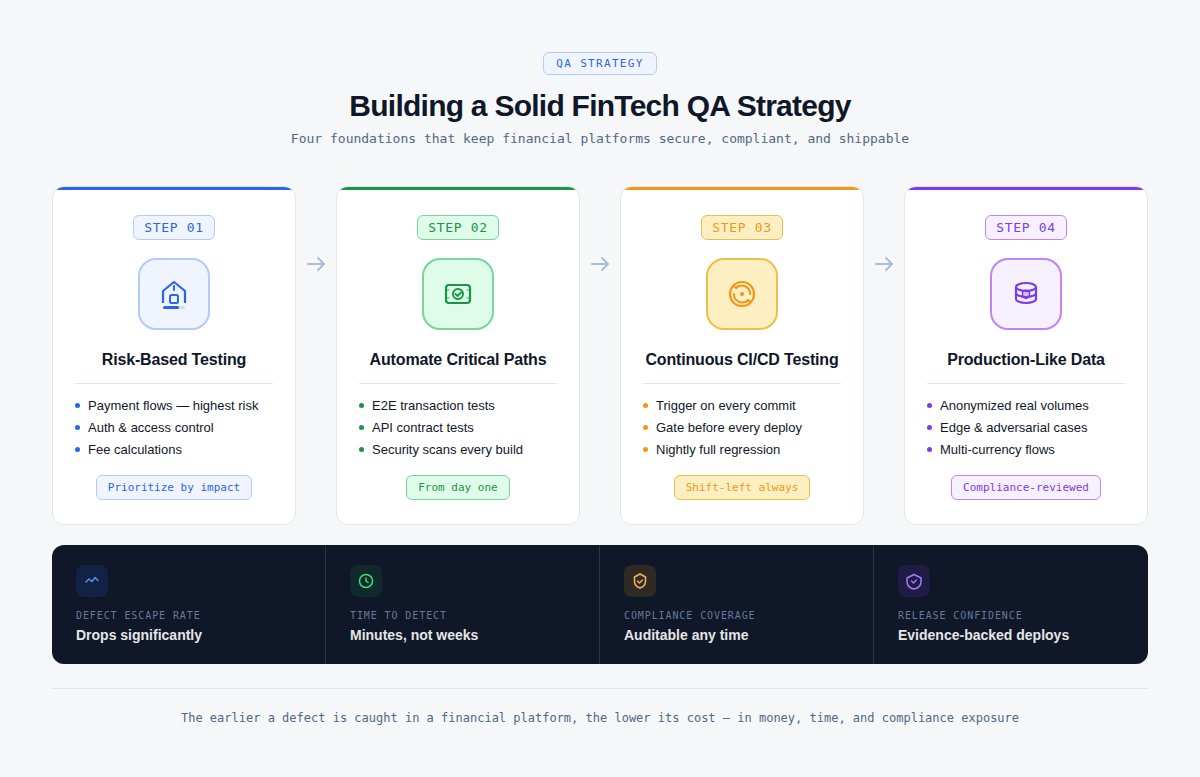
1. Start with Risk-Based Testing
In FinTech QA Services, not all features have the same level of risk.
For example:
- A small UI change is low risk
- A change in interest calculation is a high risk
In fintech testing, risk-based testing helps teams focus on what matters most. It ensures that critical areas get the most attention.
In financial software testing, you should first identify high-risk areas such as:
- Payment processing
- User authentication
- Data storage
- Fee and interest calculations
These areas should have deep testing coverage, while lower-risk features can have lighter testing.
2. Build Automation from the Start
Manual testing alone cannot support growing fintech platforms.
As systems grow, test cases also increase. Without automation, teams either:
- Slow down releases
- Reduce test coverage
Both are risky in QA for fintech applications.
In FinTech QA Services, teams should:
- Automate regression tests for critical flows
- Use tools like Playwright for end-to-end testing
- Run automated tests on every code change
This ensures bugs are found early, not later in the release cycle.
3. Integrate Testing into CI/CD
Testing only at the end of development is too late.
By that stage:
- Bugs are harder to fix
- Dependencies may have changed
- Costs increase
In fintech testing, continuous testing is essential.
With CI/CD integration in financial software testing:
- Every code change triggers automated tests
- Security checks run regularly
- Performance tests run before deployment
This approach helps teams detect and fix issues early.
4. Test with Production-Like Data
Using only test or dummy data can miss real-world issues.
In FinTech QA Services, test data should be as close as possible to real data.
Teams should:
- Use anonymized production data
- Work with legal and compliance teams
- Ensure data privacy while testing
This improves the accuracy and reliability of banking software testing.
Conclusion
FinTech QA Services are essential for building secure, reliable, and compliant financial applications where even small errors can lead to major risks. A strong approach to fintech testing ensures your platform works correctly under all conditions.
Alphabin helps teams implement scalable and effective financial software testing strategies by focusing on automation, security, and continuous testing. This makes it easier to deliver high-quality fintech products with confidence.
By investing in the right QA for fintech applications, businesses can reduce risk, improve performance, and maintain trust while growing in a highly regulated environment.


.svg)


.svg)

.png)
.png)
.png)


.svg)